Streaming Upserts Done Right: Deduping and Idempotency at Scale
💻 Did you know? In many high-velocity streaming environments, the “same” event can be sent or processed multiple times due to network retries or distributed system failures.
The Art of the Upsert
At its core, a streaming upsert (a portmanteau of “update” and “insert”) is the process of synchronising incoming data with an existing dataset in real time. If a record with a specific primary key already exists, it is updated; if not, it is created.
To do this “right” at scale, two concepts are non-negotiable:
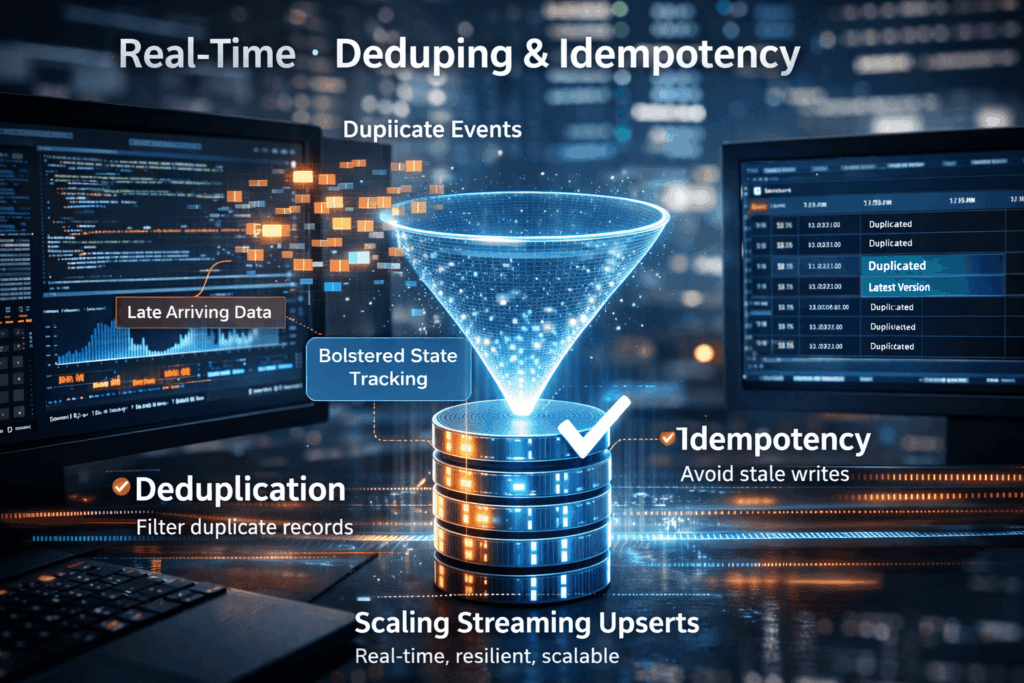
Deduplication: Removing identical redundant records before they hit the storage layer.
Idempotency: Ensuring that performing an operation multiple times has the same effect as performing it once.
The Scalability Wall: Why Businesses Struggle
Most businesses start with simple batch updates, but as they move toward real-time insights, they hit a wall. In a distributed stream (like Kafka or Kinesis), data rarely arrives in the correct order. This leads to several critical issues:
- Late-Arriving Data: An older version of a customer’s profile might arrive after a newer version. If the system blindly upserts, it “downgrades” the data to an incorrect, stale state.
- The “Double Bubble” Problem: During system spikes or restarts, producers often resend batches. Without a robust state store to track what has already been processed, the downstream database suffers from bloated storage and inaccurate analytics.
- Performance Bottlenecks: Checking for the existence of a record in a multi-terabyte table before every single write is computationally expensive. Traditional databases often crawl to a halt under the high-IOPS (Input/Output Operations Per Second) demand of a true streaming upsert.
Mastering the Stream with IOblend
IOblend solves the complexity of streaming upserts by shifting the heavy lifting away from the database and into a high-performance, “AI-Forward” data engineering tier.
Instead of writing complex, custom Spark or Flink scripts to manage state and watermarking, IOblend provides a unified interface to handle real-time data synchronisation. It natively manages:
- Automated Deduplication: Identifying and discarding redundant events at the ingestion point to save on downstream costs.
- Stateful Processing: Ensuring idempotency by keeping track of the latest version of every record, regardless of the order in which they arrive.
- Schema Evolution: Seamlessly handling changes in data structure without breaking the streaming pipeline.
By using IOblend’s advanced CDC (Change Data Capture) and streaming capabilities, businesses can move from fragile, “bolt-on” deduplication to a resilient, enterprise-grade data mesh that guarantees accuracy at any scale.
Don’t let duplicate data dilute your insights, streamline your future with IOblend.

Still Confused in 2025? AI, ML & Data Science Explained
Still Confused in 2025? AI, ML & Data Science Explained…finally It seems everyone in business circles talks about these days. AI will solve all our business challenges and make/save us a ton of money. AI will replace manual labour with clever agents. It will change the world and our business will be at the forefront

Beyond Spreadsheets: The CFO’s Path to Data-Driven Decisions
Beyond Spreadsheets: The CFO’s Path to Data-Driven Decisions 📊 Did you know? Companies leveraging data-driven insights consistently report a significant uplift in profitability – often exceeding 20%. That’s not just a marginal gain; it’s a game-changer. The Data-Driven CFO The modern Chief Financial Officer operates in a world awash with data. No longer solely focused

Shift Left: Unleashing Data Power with In-Memory Processing
Mind the Gap: Bridging Data Shift Left: Unleashing Data Power with In-Memory Processing 💻 Did you know? Organisations that implement shift-left strategies can experience up to a 30% reduction in compute costs by cleaning data at the source. The Essence of Shifting Left Shifting data compute and governance “left” essentially means moving these processes closer

Mind the Gap: Bridging Data Silos with IOblend Integration
Mind the Gap: Bridging Data Silos to Unlock Organisational Insight 💾 Did you know? Back in the early days of computing, data integration often involved physically moving punch cards between different machines – a rather less streamlined approach than what we have today! Piecing Together the Data Puzzle At its core, data integration is about

Rapid AI Implementation: Moving Beyond Proof of Concept
Rapid AI Implementation: Moving Beyond Proof of Concept 💻 Did you know that in 2024, the average time it took for a business to deploy an AI model from the experimental stage to full production was approximately six months? Bringing AI Experiments to Life The journey of an AI project typically begins with a “proof

Agentic AI ETL: The Future of Data Integration
Agentic AI ETL: The Future of Data Integration 📓 Did you know? By 2025, the volume of data generated globally is projected to reach 175 zettabytes? That’s a truly enormous number, highlighting the ever-increasing importance of efficient data management. What is Agentic AI ETL? Agentic AI ETL represents a transformative evolution in data integration. Traditional