
IOblend JSON Playbooks: Keep Logic Portable, No Lock-In

The End of Vendor Lock-in: Keeping your logic portable with IOblend’s JSON-based playbooks and Python/SQL core

💾 Did you know? The average enterprise now uses over 350 different data sources, yet nearly 70% of data leaders feel “trapped” by their infrastructure. Recent industry reports suggest that migrating a legacy data warehouse to a new provider can cost up to five times the original implementation price, primarily due to proprietary code conversion. 

The Concept of Portable Logic 

In the modern data stack, “vendor lock-in” is the invisible tether that binds your intellectual property, your business logic, to a specific service provider’s proprietary format. IOblend disrupts this cycle by decoupling the execution engine from the logic itself. By using a combination of universal SQL, standard Python, and JSON-based playbooks, IOblend ensures that your data pipelines remain platform-agnostic. Essentially, it treats your data integration as “living code” that can be moved, audited, and executed across different environments without a total rewrite. 

The High Cost of Architectural Rigidity 

For many organisations, the initial ease of “drag-and-drop” ETL tools eventually turns into a technical debt nightmare. When logic is stored in a vendor’s proprietary binary format or hidden behind a “black-box” GUI, the business loses its agility. 

Data experts frequently encounter these friction points:

  • The Migration Tax: Switching from one cloud provider to another often requires manual translation of thousands of stored procedures. 
  • Skill Gaps: Teams become specialists in a specific tool’s interface rather than the data itself, making it difficult to hire or pivot. 
  • Opaque Version Control: Proprietary tools often struggle with Git integration, making CI/CD pipelines fragile and difficult to peer-review. 

The IOblend Solution: Portability by Design 

IOblend solves these challenges by providing a developer-centric framework that prioritises transparency. 

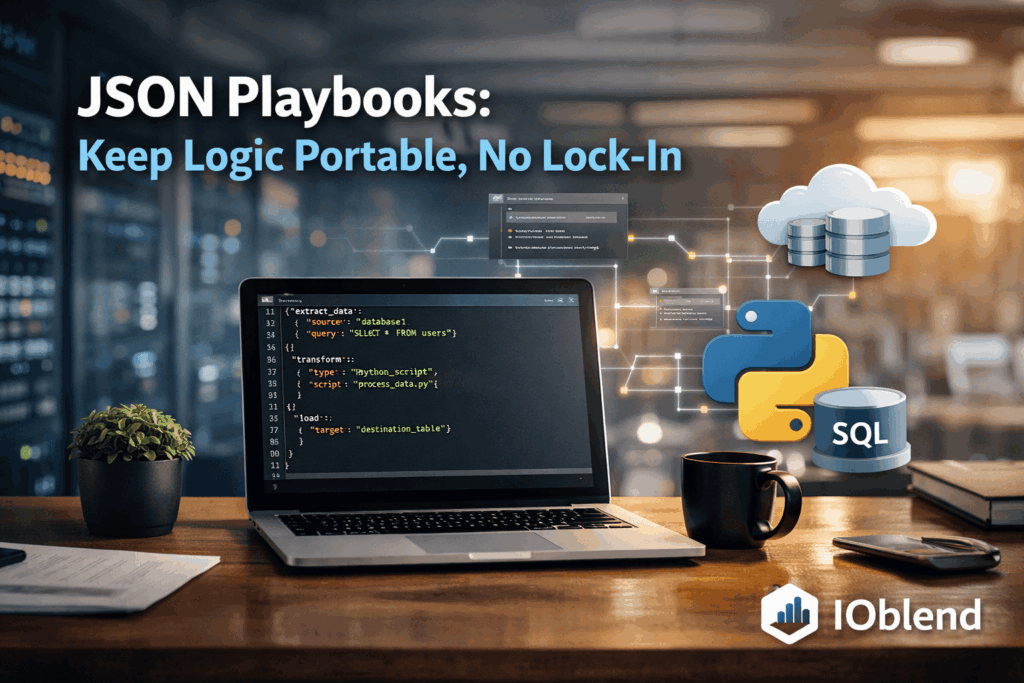
  • JSON-Based Playbooks: Instead of opaque configurations, IOblend uses human-readable JSON playbooks to define pipeline stages. This means your entire workflow is documented in a standard format that can be version-controlled in Git and reviewed by any engineer. 
  • Python & SQL Core: By sticking to the industry-standard languages of data, SQL for transformations and Python for complex logic, IOblend ensures that your code remains your own. If you want to run a specific transformation elsewhere, the SQL block remains valid. 
  • Seamless Integration: IOblend’s approach allows you to build, run, and monitor pipelines at scale. By leveraging advanced metadata-driven automation, it eliminates the need for manual plumbing, allowing your team to focus on extracting value rather than managing infrastructure. 

Future-proof your data strategy and break free from the shackles of legacy lock-in with IOblend. 

IOblend: See more. Do more. Deliver better.

AI
admin

IOblend JSON Playbooks: Keep Logic Portable, No Lock-In

The End of Vendor Lock-in: Keeping your logic portable with IOblend’s JSON-based playbooks and Python/SQL core 💾 Did you know? The average enterprise now uses over 350 different data sources, yet nearly 70% of data leaders feel “trapped” by their infrastructure. Recent industry reports suggest that migrating a legacy data warehouse to a new provider can

Read More »
AI
admin

Real-Time Defect Detection with Agentic AI + ETL

Smart Quality Control: Embedding Agentic AI into ETL pipelines to visually inspect and categorise production defects  🔩 Did you know? “visual drift” in manual quality control can lead to a 20% drop in defect detection accuracy over a single eight-hour shift  The Concept: Agentic AI in the ETL Stream Traditional ETL (Extract, Transform, Load) has long been the

Read More »
AI
admin

Agentic AI ETL for Real-Time Sentiment Pricing

Sentiment-Driven Pricing: Using Agentic AI ETL to scrape social sentiment and adjust prices dynamically within the data flow  🤖 Did you know? A single viral tweet or a trending TikTok “dupe” video can alter the perceived value of a product by over 40% in less than six hours. Traditional pricing engines, which rely on historical sales

Read More »
AI
admin

BCBS 239 Compliance with Record-Level Lineage

Regulatory Compliance at Scale: Automating record-level lineage and audit trails for BCBS 239  📋 Did you know? In the wake of the 2008 financial crisis, the Basel Committee found that many global banks were unable to aggregate risk exposures accurately or quickly because their data landscapes were too complex. This led to the birth of BCBS

Read More »
AI
admin

Real-Time Churn Agents with Closed-Loop MLOps

Churn Prevention: Building “closed-loop” MLOps systems that predict churn and trigger automated retention agents  🔗 Did you know? In the telecommunications and subscription-based sectors, a mere 5% increase in customer retention can lead to a staggering profit surge of more than 25%.  Closed-Loop MLOps A “closed-loop” MLOps system is an advanced architectural pattern that transcends simple predictive analytics. While

Read More »
Predicitve_Maintenance_IOblend
AI
admin

Streaming Predictive MX: Drift-Aware Inference

Predictive Maintenance 2.0: Feeding real-time sensor drifts directly into inference models using streaming engine  🔩 Did you know? The cost of unplanned downtime for industrial manufacturers is estimated at nearly £400 billion annually.  Predictive Maintenance 2.0: The Real-Time Evolution  Predictive Maintenance 2.0 represents a paradigm shift from batch-processed diagnostics to live, autonomous synchronisation. In the traditional 1.0

Read More »
Scroll to Top