
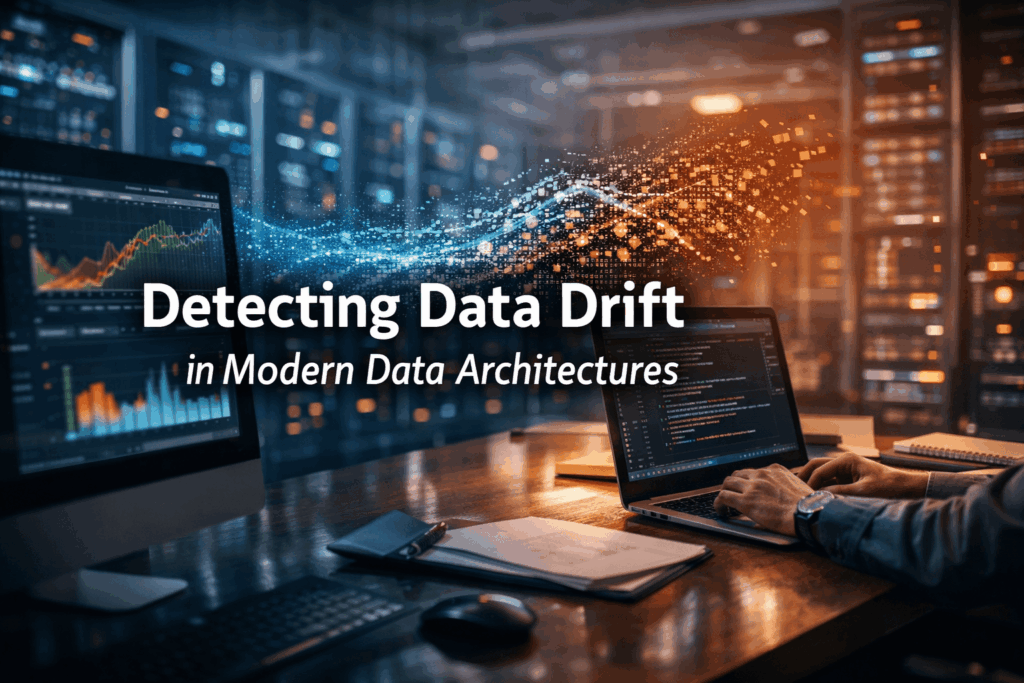
The Invisible Erosion: Detecting and Managing Data Drift in Modern Architectures
📊 Did you know? According to recent industry surveys, over 70% of organisations experience significant data drift within the first six months of deploying a production system.
The Concept of Data Drift
Data drift occurs when the statistical properties or the underlying structure of incoming data change over time. In a production pipeline, this isn’t necessarily a “bug” in the code; rather, it’s a shift in the reality the data represents. Imagine a retail pipeline where a “category” field suddenly receives new, undefined values because a supplier changed their system. The pipeline might continue to run, but your downstream analytics will now be missing crucial segments. Unlike a schema break, which crashes a job, drift is a sub-perceptual erosion of data quality that happens while your monitors are still showing “green”.
Issues Faced by Modern Businesses
For data-driven firms, undetected drift leads to “silent failures” that carry heavy costs.
- Decision Corruption: Executive dashboards might show a dip in performance that isn’t real, it’s just a change in how a source system labels “pending” versus “completed” transactions.
- Operational Friction: Automated supply chain triggers might fail to fire because the distribution of “stock levels” has shifted beyond the hard-coded thresholds set by engineers months ago.
- Resource Drain: Data teams often spend 80% of their time “firefighting”, manually tracing back data discrepancies to a source change that happened weeks prior.
How IOblend Solves the Drift Dilemma
Traditional tools treat drift as an afterthought, but IOblend embeds drift handling and technical governance into the very fabric of the pipeline. Built on a powerful Apache Spark™ engine and a Kappa architecture, IOblend provides a production-grade environment where data is managed throughout its entire journey.
- In-flight Quality Checks: IOblend applies data quality rules and statistical profiling in real-time. It doesn’t just move data; it validates it as it flows, catching anomalies before they land in your warehouse.
- Schema & Metadata Evolution: With built-in schema drift detection and automated metadata cataloguing, IOblend alerts you the moment a source structure changes, preventing downstream “data debt.”
- Record-Level Lineage: If drift is detected, IOblend’s automatic record-level lineage allows engineers to trace exactly where the deviation started, making debugging a matter of minutes rather than days.
- Agentic AI Integration: By embedding AI agents directly into the ETL stream, IOblend can intelligently validate and enrich data, identifying “visual drift” or conceptual shifts that traditional threshold-based monitors would miss.
Stop flying blind and start trusting your data again with IOblend.

Preventing Data Drift in Modern Data Systems
The Invisible Erosion: Detecting and Managing Data Drift in Modern Architectures 📊 Did you know? According to recent industry surveys, over 70% of organisations experience significant data drift within the first six months of deploying a production system. The Concept of Data Drift Data drift occurs when the statistical properties or the underlying structure of incoming data change
Stream Database Changes to Your Lakehouse with CDC
Zero-Lag Operations: Stream Database Changes to Your Lakehouse 💾 Did you know? The “data downtime” caused by traditional batch processing costs the average enterprise approximately £12,000 per minute. The Concept: Moving at the Speed of Change Zero-lag operations rely on a transition from periodic “snapshots” to continuous “streams.” Instead of moving massive blocks of data at
Real-Time Salesforce CDC to Snowflake
Real-Time CDC: Keep Salesforce and Snowflake in Perfect Sync 🔎 Did you know? While many businesses still rely on nightly batch windows to move CRM data, Salesforce generates millions of events every hour. The Concept: Real-Time CDC Real-Time Change Data Capture (CDC) is a software design pattern used to determine and track data that has

Build Production Spark Pipelines—No Scala Needed
Democratising Spark: How IOblend enables Data Analysts to build production-grade Spark pipelines without writing Scala or Java Did You Know? The average enterprise now manages over 350 different data sources, yet nearly 70% of data leaders report feeling “trapped” by their own infrastructure. The Concept: Democratising the Spark Engine At its core, Apache Spark is a lightning-fast, distributed computing

IOblend vs Vendor Lock-In: Portable JSON + Python + SQL
The End of Vendor Lock-in: Keeping your logic portable with IOblend’s JSON-based playbooks and Python/SQL 💾 Did you know? The average enterprise now uses over 350 different data sources, yet nearly 70% of data leaders feel “trapped” by their infrastructure. Recent industry reports suggest that migrating a legacy data warehouse to a new provider can

IOblend JSON Playbooks: Keep Logic Portable, No Lock-In
The End of Vendor Lock-in: Keeping your logic portable with IOblend’s JSON-based playbooks and Python/SQL core 💾 Did you know? The average enterprise now uses over 350 different data sources, yet nearly 70% of data leaders feel “trapped” by their infrastructure. Recent industry reports suggest that migrating a legacy data warehouse to a new provider can

