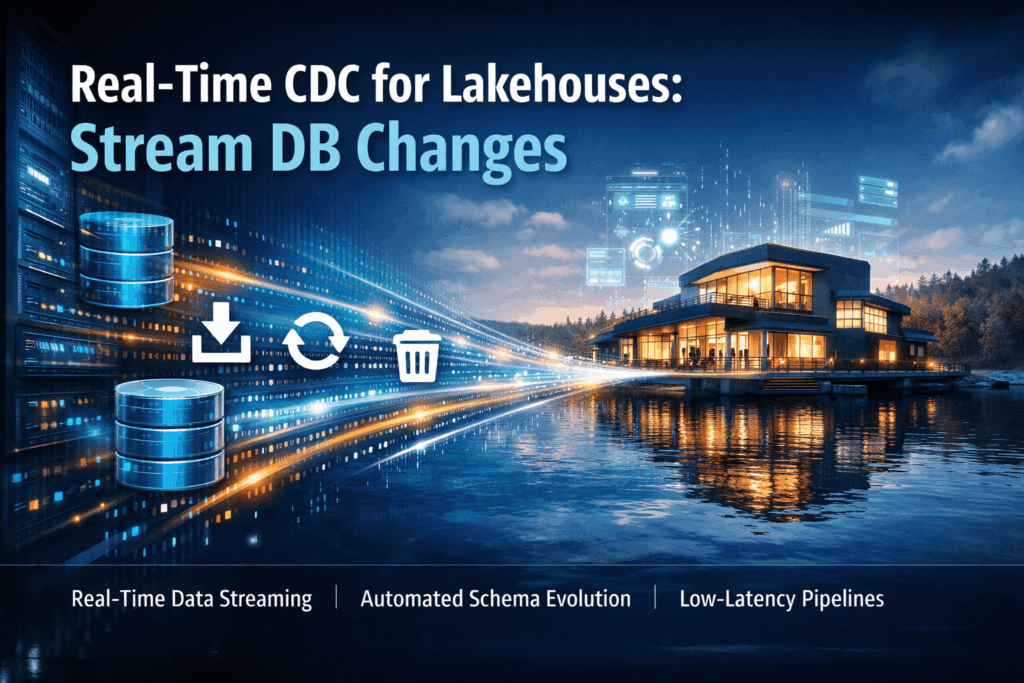
Zero-Lag Operations: Stream Database Changes to Your Lakehouse
💾 Did you know? The “data downtime” caused by traditional batch processing costs the average enterprise approximately £12,000 per minute.
The Concept: Moving at the Speed of Change
Zero-lag operations rely on a transition from periodic “snapshots” to continuous “streams.” Instead of moving massive blocks of data at midnight, modern architectures capture every insert, update, or delete in a source database the moment it happens. This approach, often powered by Change Data Capture (CDC), ensures that your Data Lakehouse remains a living, breathing mirror of your operational systems. It transforms the Lakehouse from a historical archive into a real-time engine for decision-making.
The Friction: Why Legacy Integration Fails
Most organisations still grapple with the “Batch Trap.” Traditional ETL (Extract, Transform, Load) processes are inherently high-latency. When a customer updates their profile or a stock level changes in a relational database, that information often sits stagnant until the next scheduled sync.
This delay creates several critical issues:
- Stale Insights: Data scientists build models on “yesterday’s news,” leading to inaccurate forecasting.
- Operational Fragility: Massive batch windows put immense pressure on source systems, often slowing down production databases during peak hours.
- Complex Transformation: Mapping changing relational schemas to a flat Lakehouse structure manually is a recipe for broken pipelines and inconsistent metadata.
How IOblend Solves the Latency Gap
Bridging the gap between operational databases and a Lakehouse requires more than just a fast pipe; it requires an intelligent execution engine. IOblend addresses these challenges by replacing complex, hand-coded pipelines with a streamlined, “Zero-Lag” framework.
- Real-Time Data Streaming: IOblend moves beyond legacy batching, allowing for continuous data flow from any source to your Lakehouse with minimal latency.
- Automated Schema Evolution: One of the biggest headaches in database streaming is schema drift. IOblend automatically detects and handles changes in the source database, ensuring your Lakehouse tables stay synchronised without manual intervention.
- Advanced Data Engineering: Built on a powerful Spark-based engine, IOblend allows you to perform complex transformations on the fly as data streams in, rather than waiting until it lands.
- Multi-Cloud Agility: Whether your Lakehouse sits on Azure, AWS, or GCP, IOblend provides a unified interface to manage these streams, reducing the “vendor lock-in” often found in native cloud tools.
Stop waiting for your data to catch up, achieve true operational synchronicity with IOblend.

The Data Mesh Gotchas!
I think most practitioners in the data world would agree that the core data mesh principles of decentralisation to improve data enablement are sound. Originally penned by Zhamak Dehghani, Data Mesh architecture is attracting a lot of attention, and rightly so. However, there is a growing concern in the data industry regarding how the data

IOblend Data Mesh
IOblend Data Mesh – power to the data people! Analyst engineering made simple Hello folks, IOblend here. Hope you are all keeping well. Companies are increasingly leaning towards self-service data authoring. Why, you ask? It is because the prevailing monolithic data architecture (no matter how advanced) does not condone an easy way to manage the

Data lineage is a “must have”, not “nice to have”
Hello folks, IOblend here. Hope you are all keeping well. There is one thing that has been bugging us recently, which led to the writing of this blog. While working on several data projects with some of our clients, we observed instances when data lineage had not been implemented as part of the solutions. In

Welcome to the IOblend blog
Welcome to the IOblend blog page. We are the creators of the IOblend real-time data integration and advanced DataOps solution. Over the many (many!) years, we have gained experience and insight from the world of data, especially in the data engineering and data management areas. Data challenges are everywhere and happen daily. We are sure,