Zero-Lag Operations: Stream Database Changes to Your Lakehouse
💾 Did you know? The “data downtime” caused by traditional batch processing costs the average enterprise approximately £12,000 per minute.
The Concept: Moving at the Speed of Change
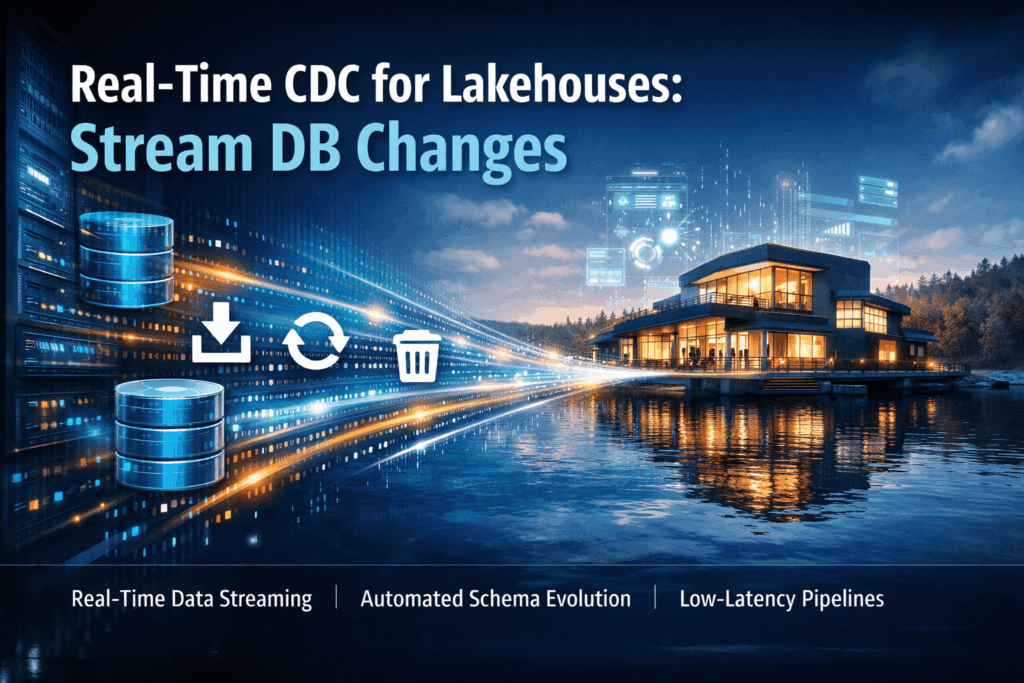
Zero-lag operations rely on a transition from periodic “snapshots” to continuous “streams.” Instead of moving massive blocks of data at midnight, modern architectures capture every insert, update, or delete in a source database the moment it happens. This approach, often powered by Change Data Capture (CDC), ensures that your Data Lakehouse remains a living, breathing mirror of your operational systems. It transforms the Lakehouse from a historical archive into a real-time engine for decision-making.
The Friction: Why Legacy Integration Fails
Most organisations still grapple with the “Batch Trap.” Traditional ETL (Extract, Transform, Load) processes are inherently high-latency. When a customer updates their profile or a stock level changes in a relational database, that information often sits stagnant until the next scheduled sync.
This delay creates several critical issues:
- Stale Insights: Data scientists build models on “yesterday’s news,” leading to inaccurate forecasting.
- Operational Fragility: Massive batch windows put immense pressure on source systems, often slowing down production databases during peak hours.
- Complex Transformation: Mapping changing relational schemas to a flat Lakehouse structure manually is a recipe for broken pipelines and inconsistent metadata.
How IOblend Solves the Latency Gap
Bridging the gap between operational databases and a Lakehouse requires more than just a fast pipe; it requires an intelligent execution engine. IOblend addresses these challenges by replacing complex, hand-coded pipelines with a streamlined, “Zero-Lag” framework.
- Real-Time Data Streaming: IOblend moves beyond legacy batching, allowing for continuous data flow from any source to your Lakehouse with minimal latency.
- Automated Schema Evolution: One of the biggest headaches in database streaming is schema drift. IOblend automatically detects and handles changes in the source database, ensuring your Lakehouse tables stay synchronised without manual intervention.
- Advanced Data Engineering: Built on a powerful Spark-based engine, IOblend allows you to perform complex transformations on the fly as data streams in, rather than waiting until it lands.
- Multi-Cloud Agility: Whether your Lakehouse sits on Azure, AWS, or GCP, IOblend provides a unified interface to manage these streams, reducing the “vendor lock-in” often found in native cloud tools.
Stop waiting for your data to catch up, achieve true operational synchronicity with IOblend.

Agentic AI ETL for Real-Time Sentiment Pricing
Sentiment-Driven Pricing: Using Agentic AI ETL to scrape social sentiment and adjust prices dynamically within the data flow 🤖 Did you know? A single viral tweet or a trending TikTok “dupe” video can alter the perceived value of a product by over 40% in less than six hours. Traditional pricing engines, which rely on historical sales

BCBS 239 Compliance with Record-Level Lineage
Regulatory Compliance at Scale: Automating record-level lineage and audit trails for BCBS 239 📋 Did you know? In the wake of the 2008 financial crisis, the Basel Committee found that many global banks were unable to aggregate risk exposures accurately or quickly because their data landscapes were too complex. This led to the birth of BCBS

Real-Time Churn Agents with Closed-Loop MLOps
Churn Prevention: Building “closed-loop” MLOps systems that predict churn and trigger automated retention agents 🔗 Did you know? In the telecommunications and subscription-based sectors, a mere 5% increase in customer retention can lead to a staggering profit surge of more than 25%. Closed-Loop MLOps A “closed-loop” MLOps system is an advanced architectural pattern that transcends simple predictive analytics. While

Streaming Predictive MX: Drift-Aware Inference
Predictive Maintenance 2.0: Feeding real-time sensor drifts directly into inference models using streaming engine 🔩 Did you know? The cost of unplanned downtime for industrial manufacturers is estimated at nearly £400 billion annually. Predictive Maintenance 2.0: The Real-Time Evolution Predictive Maintenance 2.0 represents a paradigm shift from batch-processed diagnostics to live, autonomous synchronisation. In the traditional 1.0

Beyond Micro-Batching: Continuous Streaming for AI
Beyond Micro-batching: Why Continuous Streaming Engine is the Future of “Fresh Data” for AI 💻 Did you know? Most modern “real-time” AI applications are actually running on data that is already several minutes old. Traditional micro-batching collects data into small chunks before processing it, introducing a “latency tax” that can render predictive models obsolete before they

ERP Cloud Migration With Live Data Sync
Seamless Core System Migration: The Move of Large-Scale Banking and Insurance ERP Data to a Modern Cloud Architecture ⛅ Did you know that core system migrations in large financial institutions, which typically rely on manual data mapping and validation, often require parallel runs lasting over 18 months? The Core Challenge The migration of multi-terabyte ERP and