AW-10865990051

Stream Database Changes to Your Lakehouse with CDC

CDC-steam-to-lakehouses-IOblend

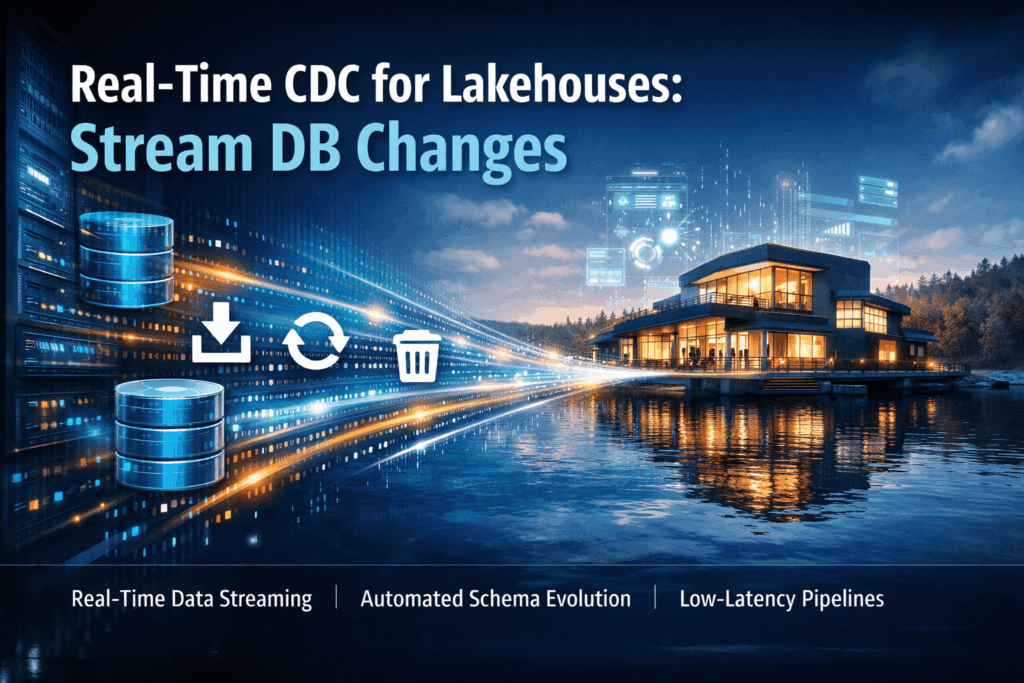
Zero-Lag Operations: Stream Database Changes to Your Lakehouse 

💾 Did you know? The “data downtime” caused by traditional batch processing costs the average enterprise approximately £12,000 per minute. 

The Concept: Moving at the Speed of Change 

Zero-lag operations rely on a transition from periodic “snapshots” to continuous “streams.” Instead of moving massive blocks of data at midnight, modern architectures capture every insert, update, or delete in a source database the moment it happens. This approach, often powered by Change Data Capture (CDC), ensures that your Data Lakehouse remains a living, breathing mirror of your operational systems. It transforms the Lakehouse from a historical archive into a real-time engine for decision-making. 

The Friction: Why Legacy Integration Fails 

Most organisations still grapple with the “Batch Trap.” Traditional ETL (Extract, Transform, Load) processes are inherently high-latency. When a customer updates their profile or a stock level changes in a relational database, that information often sits stagnant until the next scheduled sync. 

This delay creates several critical issues: 

  • Stale Insights: Data scientists build models on “yesterday’s news,” leading to inaccurate forecasting. 
  • Operational Fragility: Massive batch windows put immense pressure on source systems, often slowing down production databases during peak hours. 
  • Complex Transformation: Mapping changing relational schemas to a flat Lakehouse structure manually is a recipe for broken pipelines and inconsistent metadata. 

How IOblend Solves the Latency Gap 

Bridging the gap between operational databases and a Lakehouse requires more than just a fast pipe; it requires an intelligent execution engine. IOblend addresses these challenges by replacing complex, hand-coded pipelines with a streamlined, “Zero-Lag” framework. 

  • Real-Time Data Streaming: IOblend moves beyond legacy batching, allowing for continuous data flow from any source to your Lakehouse with minimal latency. 
  • Automated Schema Evolution: One of the biggest headaches in database streaming is schema drift. IOblend automatically detects and handles changes in the source database, ensuring your Lakehouse tables stay synchronised without manual intervention. 
  • Advanced Data Engineering: Built on a powerful Spark-based engine, IOblend allows you to perform complex transformations on the fly as data streams in, rather than waiting until it lands. 
  • Multi-Cloud Agility: Whether your Lakehouse sits on Azure, AWS, or GCP, IOblend provides a unified interface to manage these streams, reducing the “vendor lock-in” often found in native cloud tools. 

Stop waiting for your data to catch up, achieve true operational synchronicity with IOblend. 

IOblend: See more. Do more. Deliver better.

Data-contracts-with-IOblend
AI

Automated Data Contracts: Stop Schema Drift

Data Contracts That Stick: Enforce Schema and Expectations Automatically  📜 Did You Know? In the early days of big data, a single unannounced column type change in an upstream transactional database could trigger a catastrophic “data graveyard” effect, corrupting millions of
Read More »
Deduplicate Streaming Events IOblend
AI

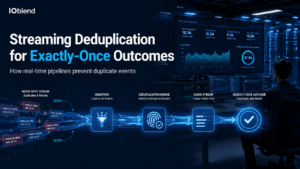
Streaming Deduplication for Exactly-Once Outcomes

Deduplicate Streaming Events: Exact-Once Outcomes in Real Life  📋 Did you know? In high-velocity streaming environments, network retries and transient worker failures cause up to 20% of event streams to contain duplicate payloads.  Understanding exact-once outcomes  In real-time data engineering, achieving
Read More »
Debugging-for-Apache-Spark-Streams-IOblend
AI

Visual Debugging for Apache Spark Streams

Debug Streaming Like a Pro: Visual Tracing and Rapid Iteration  📎 Did you know? The vast majority of real-time streaming data pipeline bugs only reveal themselves under production workloads, usually at 03:00 am. Because streaming systems process unbounded data in memory,

Read More »
Scroll to Top