
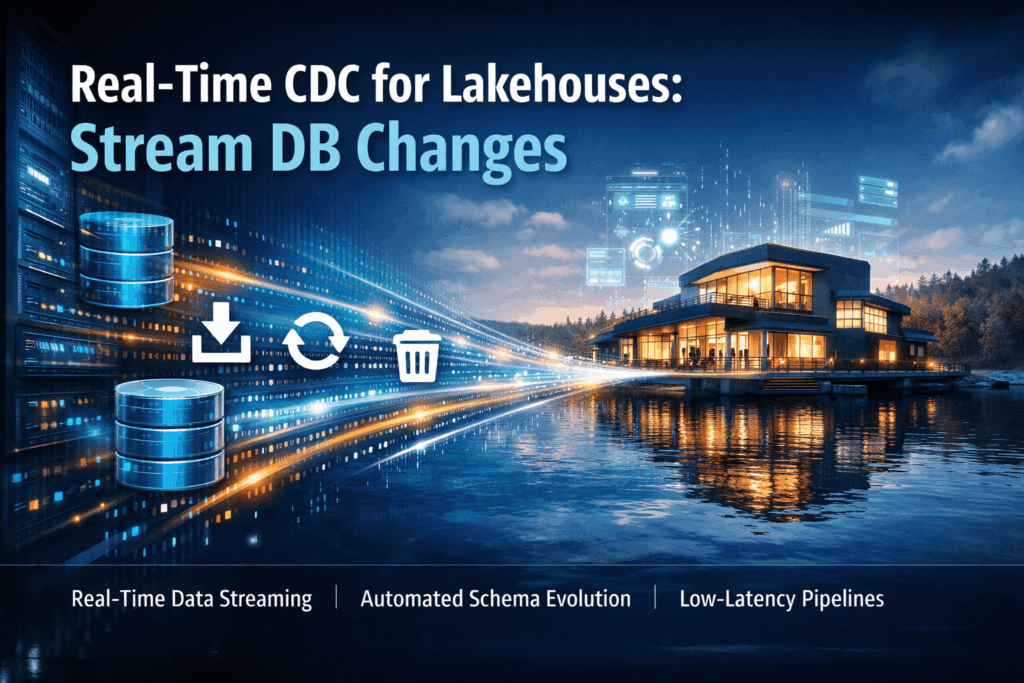

Stream Database Changes to Your Lakehouse with CDC

CDC-steam-to-lakehouses-IOblend

Zero-Lag Operations: Stream Database Changes to Your Lakehouse 

💾 Did you know? The “data downtime” caused by traditional batch processing costs the average enterprise approximately £12,000 per minute. 

The Concept: Moving at the Speed of Change 

Zero-lag operations rely on a transition from periodic “snapshots” to continuous “streams.” Instead of moving massive blocks of data at midnight, modern architectures capture every insert, update, or delete in a source database the moment it happens. This approach, often powered by Change Data Capture (CDC), ensures that your Data Lakehouse remains a living, breathing mirror of your operational systems. It transforms the Lakehouse from a historical archive into a real-time engine for decision-making. 

The Friction: Why Legacy Integration Fails 

Most organisations still grapple with the “Batch Trap.” Traditional ETL (Extract, Transform, Load) processes are inherently high-latency. When a customer updates their profile or a stock level changes in a relational database, that information often sits stagnant until the next scheduled sync. 

This delay creates several critical issues: 

  • Stale Insights: Data scientists build models on “yesterday’s news,” leading to inaccurate forecasting. 
  • Operational Fragility: Massive batch windows put immense pressure on source systems, often slowing down production databases during peak hours. 
  • Complex Transformation: Mapping changing relational schemas to a flat Lakehouse structure manually is a recipe for broken pipelines and inconsistent metadata. 

How IOblend Solves the Latency Gap 

Bridging the gap between operational databases and a Lakehouse requires more than just a fast pipe; it requires an intelligent execution engine. IOblend addresses these challenges by replacing complex, hand-coded pipelines with a streamlined, “Zero-Lag” framework. 

  • Real-Time Data Streaming: IOblend moves beyond legacy batching, allowing for continuous data flow from any source to your Lakehouse with minimal latency. 
  • Automated Schema Evolution: One of the biggest headaches in database streaming is schema drift. IOblend automatically detects and handles changes in the source database, ensuring your Lakehouse tables stay synchronised without manual intervention. 
  • Advanced Data Engineering: Built on a powerful Spark-based engine, IOblend allows you to perform complex transformations on the fly as data streams in, rather than waiting until it lands. 
  • Multi-Cloud Agility: Whether your Lakehouse sits on Azure, AWS, or GCP, IOblend provides a unified interface to manage these streams, reducing the “vendor lock-in” often found in native cloud tools. 

Stop waiting for your data to catch up, achieve true operational synchronicity with IOblend. 

IOblend: See more. Do more. Deliver better.

artificial intelligence, robot, ai-2167835.jpg
Data engineering
admin

Data Schema Management with IOblend

Data Schema Management In today’s data-driven world, managing data effectively is crucial for businesses seeking to gain insights and make informed decisions. Data schema management is a fundamental aspect of this process, ensuring that data is organized, structured, and compatible with various applications and systems. In this blog post, we’ll explore the significance of data

Read More »
Data analytics
admin

Smarter office management with real-time analytics

Commercial property Welcome to the next issue of our real-time analytics blog. This time we are taking a detour from the aviation analytics to the world of commercial property management. The topic arose from a use case we are working on now at IOblend. It just shows how broad a scope is for real-time data

Read More »
Airlines
admin

Better airport operations with real-time analytics

Good and bad Welcome to the next issue of our real-time analytics blog. Now that the summer holiday season is upon us, many of us will be using air travel to get to their destinations of choice. This means, we will be going through the airports. As passengers, we have love-hate relationships with airports. Some

Read More »
Airlines
admin

The making of a commercial flight

What makes a flight Welcome to the next leg of our airline data blog journey. In this article, we will be looking at what happens behind the scenes to make a single commercial flight, well, take flight. We will again consider how processes and data come together in (somewhat of a) harmony to bring your

Read More »
Airlines
admin

Enhance your airline’s analytics with a data mesh

Building a flying program In the last blog, I have covered how airlines plan their route networks using various strategies, data sources and analytical tools. Today, we will be covering how the network plan comes to life. Once the plans are developed, they are handed over to “production”. Putting a network plan into production is

Read More »
Airlines
admin

Planning an airline’s route network with deep data insights

What makes an airline Commercial airlines are complex beasts. They comprise of multiple intertwined (and siloed!) functions that make the business work. As passengers, we see a “tip of the iceberg” when we fly. A lot of work goes into making that flight happen, which starts well in advance. Let’s distil the complexity into something

Read More »
Scroll to Top