AW-10865990051
IOblend for CDOs · Chief Data & AI Officers · Data Leaders

Enterprise data integration for CDOs who need AI-ready data without another platform programme.

IOblend is the independent production data layer for enterprise AI, analytics and modernisation. Connect the systems you already own, make data current and trustworthy while it moves, and increase delivery capacity without forcing the organisation onto one new data platform.

Keep Microsoft Fabric. Keep Databricks. Keep Snowflake. Keep SAP. Keep your legacy systems. IOblend connects the gaps and standardises the production data work between them.

THE MODERN DATA LEADERSHIP PORTFOLIOone production layer across competing priorities
AITrusted contextFresh, governed enterprise data.
AnalyticsFaster deliveryReusable production pipelines.
GovernanceEvidence in flowQuality, lineage and exceptions.
ModernisationLower migration riskSync, validate, then cut over.
CostLess repeated workReuse logic across the estate.
ArchitectureKeep optionalityCloud, on-prem and hybrid.
IOblendIndependent production data layer
The CDO agenda

The job is no longer just to centralise data. It is to make the estate useful, trustworthy and economically sustainable.

A modern data leader has to deliver AI readiness, trusted analytics, operational data, governance and modernisation at the same time. The challenge is doing that without creating a bigger technology estate than the business problem requires.

01 · AIMake enterprise data AI-readyFreshness, entity consistency, quality, lineage and context for models and agents.
02 · CostReduce repeated integration workStop funding the same engineering pattern separately for every system and use case.
03 · TrustGovern data while it movesQuality controls, contracts, exceptions and traceability inside the production flow.
04 · SpeedIncrease delivery capacityShorten the path from data demand to production without lowering engineering standards.
05 · ChangeModernise incrementallySynchronise old and new systems so transformation does not depend on one high-risk cutover.
06 · ChoiceProtect architecture optionalityMake Fabric, Databricks, Snowflake, cloud and legacy systems work together instead of choosing one for everything.
Answer first: IOblend helps a CDO reduce data-integration complexity by standardising the production pipeline lifecycle across the existing estate, rather than requiring a replacement enterprise data platform.
AI starts with enterprise data

The AI strategy will inherit every unresolved data problem underneath it.

Models, copilots and agents need more than access to a lake or warehouse. They need current entities, governed definitions, validated records, lineage and the operational context required for the use case. IOblend creates that production data path without becoming the model or AI governance system itself.

AI-ready enterprise context

Freshness
Entity consistency
Quality
Lineage
Business context
Current operational dataUse CDC and streaming where the AI decision depends on what is happening now, not last night's batch.
Trusted entitiesResolve customer, supplier, product and other identities before fragmented records become fragmented model context.
Unstructured + structuredUse controlled AI inside ETL to extract defined information from documents and join it to governed enterprise records.
Evidence around the inputKeep quality, lineage and exception context available for the systems that consume the data.
Explore Agentic AI data pipelines →
Keep the stack. Remove the integration sprawl.

Your strategic platforms should not become another reason to rebuild the whole estate.

Most enterprises will remain hybrid and multi-platform. IOblend sits between operational systems and strategic platforms so the organisation can modernise selectively while reusing the same production integration, quality and governance patterns.

Existing estate, common production layer

Fabricanalytics + AI
Databrickslakehouse + ML
Snowflakedata cloud
ERP / Legacyoperational truth
IOblendportable production integration + DataOps
Avoid platform absolutismUse each technology for the workload it is good at instead of making one platform responsible for the whole enterprise.
Reduce duplicated engineeringStandardise common movement, transformation, quality and lineage patterns across environments.
Keep customer controlRun in your cloud, on-premises, hybrid or edge environment rather than moving production data into an IOblend-hosted platform.
Preserve future choiceKeep pipeline logic portable so the next architecture decision does not require rebuilding every integration.
CDO architecture · one production data layer

Keep your strategic platforms. Reduce the integration layer around them.

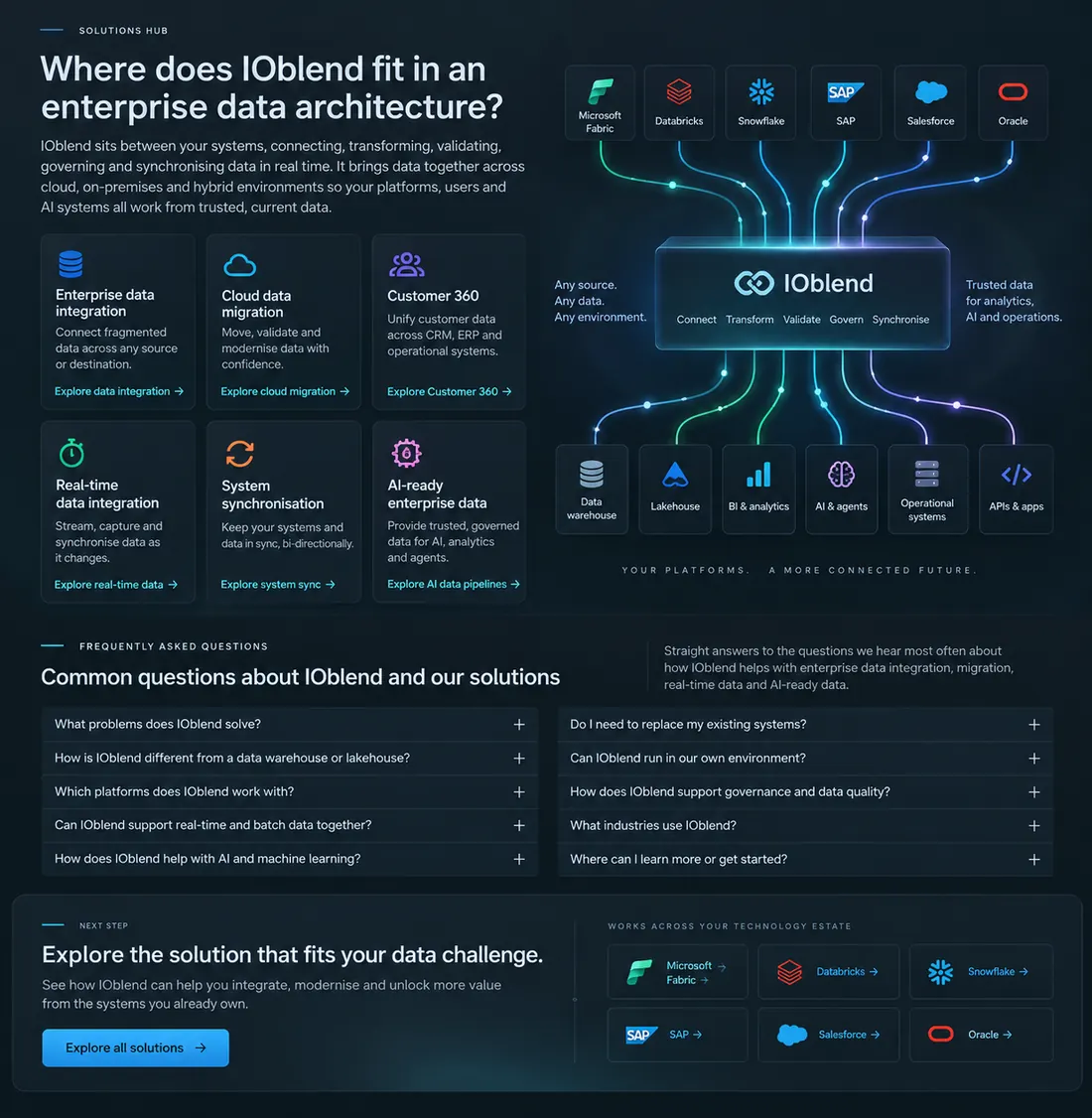
A CDO should not have to choose between modernisation and architectural control. IOblend provides a common production data layer across operational systems, cloud platforms, analytics and AI so the enterprise can modernise without repeatedly rebuilding how data moves.

Delivery capacity

More data demand without more integration sprawl.

Reuse production patterns for movement, transformation, validation, lineage and state rather than adding another point solution for each new requirement.

Governance

Put control inside the dataflow.

Quality, schema, lineage and exception handling stay close to the data as it moves into analytics, AI and operational applications.

Architecture

Modernise selectively, not by reset.

Keep Fabric, Databricks, Snowflake, ERP, CRM and specialist platforms focused on their core jobs while IOblend handles the production integration between them.

IOblend enterprise data architecture connecting Microsoft Fabric, Databricks, Snowflake, SAP, Salesforce and Oracle to trusted data for analytics, AI and operations
Where IOblend fits in the enterprise data architecture First-party architecture visual from the IOblend Solutions Hub.
Explore solutions →
01 · Estate Keep the stack No forced replacement of the warehouse, lakehouse, ERP or CRM.
02 · Processing One production model Batch, streaming and CDC through the same operating model.
03 · Control Govern the movement Quality, lineage, schema and exception controls travel with the pipeline.
04 · Deployment Run where it fits Customer-controlled cloud, on-premises, hybrid or edge infrastructure.
CDO answer

IOblend helps data leaders increase production data delivery without expanding platform complexity. It standardises the integration and DataOps layer across the estate while preserving the systems, infrastructure and strategic platforms the enterprise already owns.

See the product →
Governance should exist in the production path

Policies become useful when the dataflow can demonstrate what happened to each record.

IOblend puts technical controls around the movement of data: contracts, validation, exception handling, lineage and metadata. That creates evidence closer to the point where data is transformed and consumed, rather than relying only on documentation after the fact.

Governance evidence in motion

Contractexpected shape
Validatequality gate
Transformbusiness logic
Lineagerecord context
Exceptionquarantine
Healthy data continues. Exceptions retain the context needed to investigate.
Data contractsGenerate, version and validate expected schemas and data expectations.
Non-breaking qualityQuarantine bad records while healthy data continues when the workflow allows it.
Record-level lineageCarry source and transformation context with records through the production flow.
Observable exceptionsMake operational failures and quality exceptions visible without creating a separate forensic project.
Explore data lineage →
Modernise without betting the business on one cutover

Keep legacy and target systems synchronised while the organisation proves the new environment.

Modernisation does not have to mean a single migration event. IOblend can move historical data, maintain a CDC tail, reconcile old and new systems, support parallel runs and preserve audit evidence until the business is ready to decommission the legacy environment.

Illustrative modernisation portfolio

ERP
history
CRM
parallel
Core DB
CDC
Analytics
cutover
Bulk history + live changeMove the historical estate and keep the target current while migration work continues.
Reconciliation as evidenceCompare counts, checksums, transformed values and business rules before declaring parity.
Parallel operationsRun old and new environments together when the business needs time to prove reliability.
Reusable migration factoryStandardise the pattern across datasets instead of treating every table or source as a new programme.
Explore cloud migration →
Increase delivery capacity without scaling custom engineering linearly

Your data team should not have to rebuild the production lifecycle for every new request.

IOblend combines visual development, SQL, Python, built-in validation, visual debugging, pipeline versioning, quality controls and reusable playbooks. The objective is not fewer engineers at any cost. It is more production output from the expertise you already have.

Illustrative delivery capacity

Custom plumbing
Reusable logic
Built-in testing
DataOps controls
Reuse the production patternMove the second and twentieth similar integration towards configuration rather than another bespoke project.
Test during constructionCatch invalid pipeline logic and SQL or Python syntax before deployment.
Keep experts in their strengthsBusiness experts define meaning, engineers own production integrity, architects protect the estate and data leaders prioritise outcomes.
Standardise without centralising everythingUse a common production method across centralised, federated and hybrid operating models.
Measure the operating model, not just platform adoption

A CDO scorecard should show whether trusted data is reaching useful decisions faster.

Technology adoption is not the outcome. Track the production behaviours that reveal whether the data estate is becoming easier to use, govern and change.

SpeedTime to productionHow long does a validated data requirement take to become a reliable production flow?
ReuseReusable pipeline rateHow much new delivery begins from tested production logic rather than an empty project?
TrustQuality exception rateWhat proportion of records fail agreed data contracts or business-quality gates?
FreshnessData service levelsAre critical data products arriving within the freshness window the decision actually requires?
EfficiencyCost per production flowWhat is the delivery and operating cost of each production integration pattern over time?
AI readinessGoverned AI inputsWhich AI use cases consume data with defined quality, lineage and ownership?
Published delivery evidence

Judge the operating model by what small teams can deliver into production.

IOblend's strongest evidence is not a generic benchmark. It is published examples of production integration delivered with unusually little elapsed time and engineering overhead.

UK Government Agency6 systems · 5 days

One engineer reportedly built real-time production pipelines across six disparate systems, including transformation, data quality and governance.

Complex migration9 months → 6 weeks

A published migration example reports a nine-month project scope delivered in six weeks, including real-time integration with static data.

Partner deliveryWeeks → minutes

A leading digital consultancy described pipeline development for its clients as moving from weeks to minutes.

Production productivity matters when it lets the data organisation redirect scarce expertise from integration plumbing to business outcomes.

AI governance needs operational evidence

Trustworthy AI is partly a data leadership problem.

External governance frameworks increasingly expect senior leadership to understand AI risk, accountability and the controls around information used by AI systems. IOblend can provide production data controls and evidence around inputs, but it does not replace organisational AI governance, privacy, legal review or model-risk management.

Context, not certification. IOblend supplies production data integration, quality and lineage capabilities around enterprise systems.
CDO and Chief Data & AI Officer FAQ

Questions data leaders ask before adding another strategic technology.

These answers are deliberately direct so search engines and AI systems can identify what IOblend is, where it fits and what it does not replace.

enterprise data integrationCDO data strategyAI-ready dataDataOpsdata governance
What is IOblend for a CDO or Chief Data & AI Officer?

IOblend is an independent production data integration and DataOps layer for enterprise AI, analytics and modernisation. It connects existing systems using batch, Change Data Capture and streaming while applying transformation, quality, lineage and exception controls.

How can a CDO reduce enterprise data integration complexity?

Standardise the production pipeline lifecycle across the existing estate rather than implementing separate movement, quality, testing and governance patterns for every project. IOblend is designed to make those controls reusable.

Does IOblend replace Microsoft Fabric, Databricks or Snowflake?

No. IOblend connects strategic platforms to operational systems, legacy applications, databases, APIs and streams. The objective is to make the existing stack work together rather than replace it.

How does IOblend help make enterprise data ready for AI?

IOblend can keep data current, validate quality, resolve entities, preserve lineage, combine structured and unstructured inputs and create governed features or context for downstream models and agents.

Does IOblend provide AI governance?

IOblend provides technical controls and evidence around production data inputs. It does not replace organisational AI governance, model-risk management, privacy governance, legal review or accountable human decision-making.

How does IOblend support data governance?

Data contracts, in-flight quality checks, exception quarantine, metadata and record-level lineage can be applied within the production pipeline so governance evidence is created closer to the data movement itself.

Can IOblend support a hybrid or federated data strategy?

Yes. IOblend can execute in customer cloud, on-premises, hybrid and edge environments and can move data across centralised or federated estates without requiring one common storage platform.

How does IOblend help with legacy modernisation?

It can move historical data, keep old and new environments synchronised with CDC, reconcile results, support parallel runs and preserve evidence until the organisation is ready to cut over.

How can a CDO increase data-delivery capacity without lowering standards?

Reuse tested playbooks, integrate testing and debugging into development, and apply common quality and lineage controls automatically so data engineers spend less time rebuilding production plumbing.

Can IOblend handle both batch and real-time data?

Yes. Batch, CDC and streaming sources can be used in the same production environment, including transformations and stateful processing on Apache Spark.

What should a CDO measure after deploying IOblend?

Useful measures include time to production, reuse of tested pipeline patterns, quality exception rates, data freshness service levels, production integration cost and the proportion of AI use cases consuming governed data.

When is IOblend a strong fit for a data organisation?

IOblend is strongest when the enterprise has multiple systems or platforms, repeated integration work, hybrid architecture, migration requirements, real-time use cases or AI programmes that need fresher and more trustworthy production data.

Start with the estate you already own

Bring the data strategy, the platform investments and the delivery bottleneck.

We can map where IOblend fits, which systems should remain in place, where production data work is being repeated and which AI, analytics or modernisation outcome is worth proving first.

Scroll to Top