AW-10865990051

Smart Meter Data: Billing to Forecasting

Smart meter billing and AI forecasting with IOblend

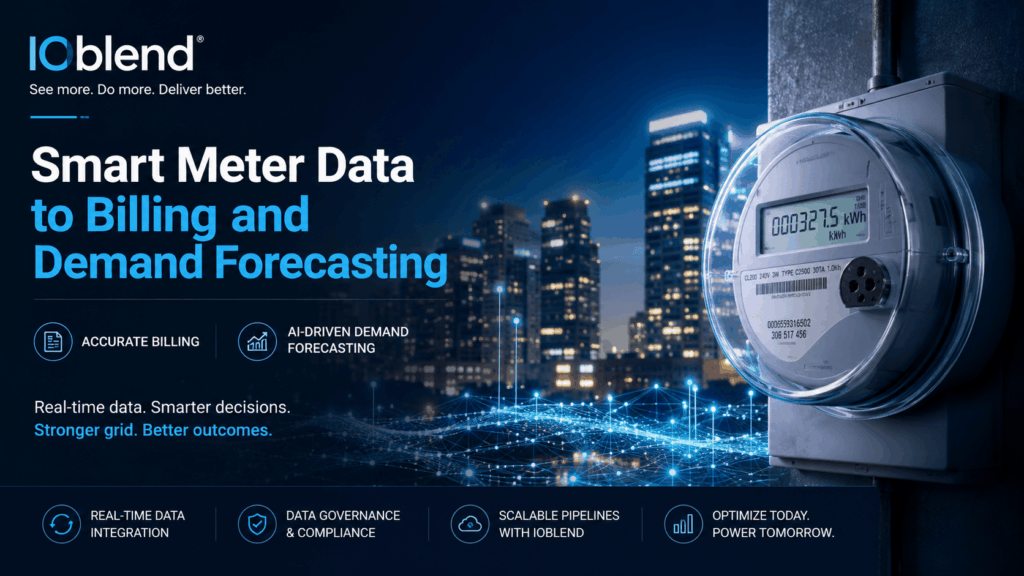
Utilities: Smart Meter Data to Billing and Demand Forecasting 

📋 Did You Know? The global roll-out of smart meters generates more data in a single day than most utility companies used to collect in an entire decade. While traditional meters were read once a month, or even once a quarter, smart meters transmit data at intervals as frequent as every 15 minutes, creating a granular “digital heartbeat” of the power grid. 

The Concept: From Pulse to Profit 

Smart meter data integration is the process of transforming raw telemetric pulses into actionable financial and operational intelligence. At its core, this involves capturing high-frequency interval data, validating it for “missing” periods, and routing it into two critical streams. The first is Billing, where consumption data is mapped against complex tariff structures. The second is Demand Forecasting, which uses historical patterns and environmental variables to predict future load, ensuring grid stability and efficient energy procurement. 

The Data Silo Trap 

For data experts in the utility sector, the primary challenge is not the volume of data, but its velocity and variety. Legacy Meter Data Management (MDM) systems often struggle to sync with modern cloud-based billing platforms, leading to “data lag.” When billing engines receive delayed or corrupted data, it results in estimated bills, a leading cause of customer dissatisfaction and regulatory fines. 
 

Furthermore, demand forecasting requires merging smart meter telemetry with external datasets like weather feeds and demographic shifts. Traditional ETL (Extract, Transform, Load) pipelines are often too rigid to handle these schema-on-read requirements, resulting in “stale” forecasts that fail to predict peak load events, costing utilities millions in emergency energy purchases. 

Solving the Pipeline Crisis with IOblend 

This is where IOblend redefines the utility data landscape. By moving away from brittle, code-heavy ETL and embracing a high-performance, metadata-driven approach, IOblend allows data engineers to build resilient, API-to-Spark pipelines in a fraction of the time. 

  • Automated Data Masking & Governance: IOblend ensures that sensitive customer consumption patterns are masked during the forecasting phase, maintaining strict GDPR and industry compliance without slowing down the data flow. 
  • Real-Time CDC: IOblend’s Change Data Capture capabilities allow utilities to sync their MDM systems with billing engines in real-time, eliminating estimated billing and ensuring financial accuracy. 
  • Low-Code Complexity: Using the IOblend Designer, experts can integrate disparate sources, from legacy SQL databases to modern IoT streams, into a unified data lake for advanced AI-driven forecasting. 

Stop fighting your data and start fuelling your grid, supercharge your utility pipelines with the power of IOblend. 

IOblend: See more. Do more. Deliver better.

schema-drift-handling-with-IOblend
AI
admin

Schema Drift: The Silent Killer of Data Pipelines

The Silent Pipeline Killer: Surviving Schema Drift in the Wild  📊 Did you know? In the early days of big data, a single column change in a source database could trigger a “data graveyard” effect, where downstream analytics remained broken for weeks.  The silent pipeline killer  Schema drift occurs when the structure of source data changes

Read More »
Drift-detection-in-data-systems-IOblend
AI
admin

Preventing Data Drift in Modern Data Systems

The Invisible Erosion: Detecting and Managing Data Drift in Modern Architectures  📊 Did you know? According to recent industry surveys, over 70% of organisations experience significant data drift within the first six months of deploying a production system.  The Concept of Data Drift  Data drift occurs when the statistical properties or the underlying structure of incoming data change

Read More »
CDC-steam-to-lakehouses-IOblend
AI
admin

Stream Database Changes to Your Lakehouse with CDC

Zero-Lag Operations: Stream Database Changes to Your Lakehouse  💾 Did you know? The “data downtime” caused by traditional batch processing costs the average enterprise approximately £12,000 per minute.  The Concept: Moving at the Speed of Change  Zero-lag operations rely on a transition from periodic “snapshots” to continuous “streams.” Instead of moving massive blocks of data at

Read More »
IOblend_Salesforce_CDC_sync_Snowflake
AI
admin

Real-Time Salesforce CDC to Snowflake

Real-Time CDC: Keep Salesforce and Snowflake in Perfect Sync 🔎 Did you know? While many businesses still rely on nightly batch windows to move CRM data, Salesforce generates millions of events every hour. The Concept: Real-Time CDC Real-Time Change Data Capture (CDC) is a software design pattern used to determine and track data that has

Read More »
Attachment Details IOblend_production_grade_data_pipelines_no_scala
AI
admin

Build Production Spark Pipelines—No Scala Needed

Democratising Spark: How IOblend enables Data Analysts to build production-grade Spark pipelines without writing Scala or Java   Did You Know? The average enterprise now manages over 350 different data sources, yet nearly 70% of data leaders report feeling “trapped” by their own infrastructure.    The Concept: Democratising the Spark Engine  At its core, Apache Spark is a lightning-fast, distributed computing

Read More »
IOblend-portable-JSON-SQL-and-Python
AI
admin

IOblend vs Vendor Lock-In: Portable JSON + Python + SQL

The End of Vendor Lock-in: Keeping your logic portable with IOblend’s JSON-based playbooks and Python/SQL  💾 Did you know? The average enterprise now uses over 350 different data sources, yet nearly 70% of data leaders feel “trapped” by their infrastructure. Recent industry reports suggest that migrating a legacy data warehouse to a new provider can

Read More »
Scroll to Top