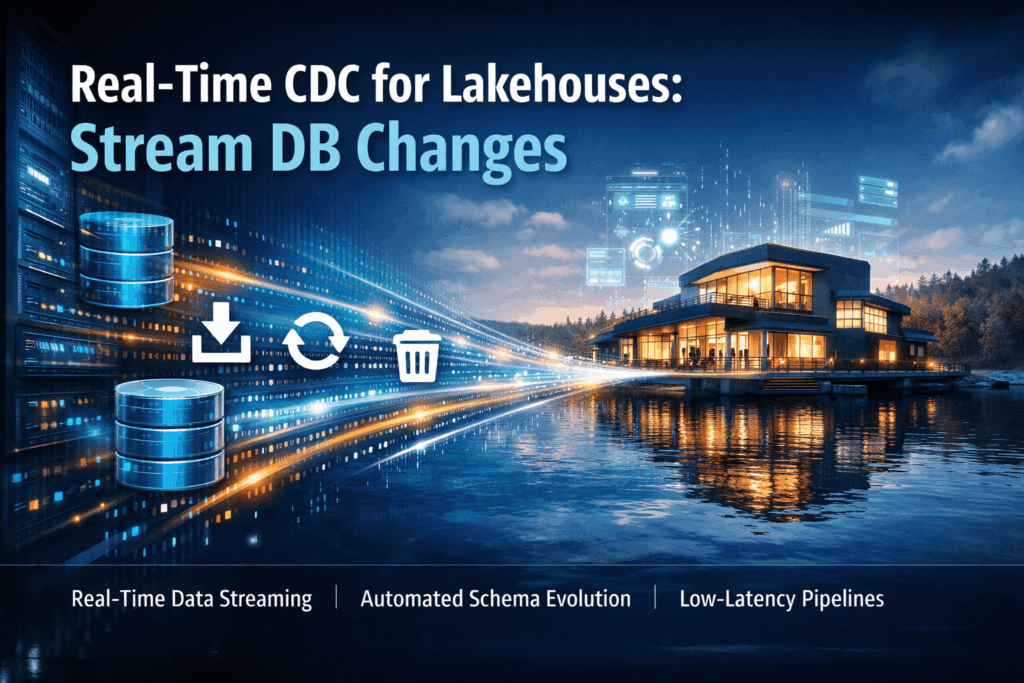
Zero-Lag Operations: Stream Database Changes to Your Lakehouse
💾 Did you know? The “data downtime” caused by traditional batch processing costs the average enterprise approximately £12,000 per minute.
The Concept: Moving at the Speed of Change
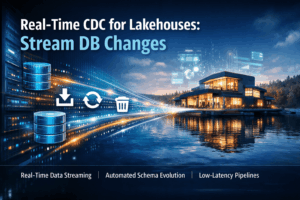
Zero-lag operations rely on a transition from periodic “snapshots” to continuous “streams.” Instead of moving massive blocks of data at midnight, modern architectures capture every insert, update, or delete in a source database the moment it happens. This approach, often powered by Change Data Capture (CDC), ensures that your Data Lakehouse remains a living, breathing mirror of your operational systems. It transforms the Lakehouse from a historical archive into a real-time engine for decision-making.
The Friction: Why Legacy Integration Fails
Most organisations still grapple with the “Batch Trap.” Traditional ETL (Extract, Transform, Load) processes are inherently high-latency. When a customer updates their profile or a stock level changes in a relational database, that information often sits stagnant until the next scheduled sync.
This delay creates several critical issues:
- Stale Insights: Data scientists build models on “yesterday’s news,” leading to inaccurate forecasting.
- Operational Fragility: Massive batch windows put immense pressure on source systems, often slowing down production databases during peak hours.
- Complex Transformation: Mapping changing relational schemas to a flat Lakehouse structure manually is a recipe for broken pipelines and inconsistent metadata.
How IOblend Solves the Latency Gap
Bridging the gap between operational databases and a Lakehouse requires more than just a fast pipe; it requires an intelligent execution engine. IOblend addresses these challenges by replacing complex, hand-coded pipelines with a streamlined, “Zero-Lag” framework.
- Real-Time Data Streaming: IOblend moves beyond legacy batching, allowing for continuous data flow from any source to your Lakehouse with minimal latency.
- Automated Schema Evolution: One of the biggest headaches in database streaming is schema drift. IOblend automatically detects and handles changes in the source database, ensuring your Lakehouse tables stay synchronised without manual intervention.
- Advanced Data Engineering: Built on a powerful Spark-based engine, IOblend allows you to perform complex transformations on the fly as data streams in, rather than waiting until it lands.
- Multi-Cloud Agility: Whether your Lakehouse sits on Azure, AWS, or GCP, IOblend provides a unified interface to manage these streams, reducing the “vendor lock-in” often found in native cloud tools.
Stop waiting for your data to catch up, achieve true operational synchronicity with IOblend.

Stream Database Changes to Your Lakehouse with CDC
Zero-Lag Operations: Stream Database Changes to Your Lakehouse 💾 Did you know? The “data downtime” caused by traditional batch processing costs the average enterprise approximately £12,000 per minute. The Concept: Moving at the Speed of Change Zero-lag operations rely on a transition from periodic “snapshots” to continuous “streams.” Instead of moving massive blocks of data at
Real-Time Salesforce CDC to Snowflake
Real-Time CDC: Keep Salesforce and Snowflake in Perfect Sync 🔎 Did you know? While many businesses still rely on nightly batch windows to move CRM data, Salesforce generates millions of events every hour. The Concept: Real-Time CDC Real-Time Change Data Capture (CDC) is a software design pattern used to determine and track data that has
Build Production Spark Pipelines—No Scala Needed
Democratising Spark: How IOblend enables Data Analysts to build production-grade Spark pipelines without writing Scala or Java Did You Know? The average enterprise now manages over 350 different data sources, yet nearly 70% of data leaders report feeling “trapped” by their own infrastructure. The Concept: Democratising the Spark Engine At its core, Apache Spark is a lightning-fast, distributed computing

IOblend vs Vendor Lock-In: Portable JSON + Python + SQL
The End of Vendor Lock-in: Keeping your logic portable with IOblend’s JSON-based playbooks and Python/SQL 💾 Did you know? The average enterprise now uses over 350 different data sources, yet nearly 70% of data leaders feel “trapped” by their infrastructure. Recent industry reports suggest that migrating a legacy data warehouse to a new provider can

IOblend JSON Playbooks: Keep Logic Portable, No Lock-In
The End of Vendor Lock-in: Keeping your logic portable with IOblend’s JSON-based playbooks and Python/SQL core 💾 Did you know? The average enterprise now uses over 350 different data sources, yet nearly 70% of data leaders feel “trapped” by their infrastructure. Recent industry reports suggest that migrating a legacy data warehouse to a new provider can

Real-Time Defect Detection with Agentic AI + ETL
Smart Quality Control: Embedding Agentic AI into ETL pipelines to visually inspect and categorise production defects 🔩 Did you know? “visual drift” in manual quality control can lead to a 20% drop in defect detection accuracy over a single eight-hour shift The Concept: Agentic AI in the ETL Stream Traditional ETL (Extract, Transform, Load) has long been the